The McCoy family highway accident
The Journey CollectionThe McCoy family highway accident is the book’s defining emergency of domestic vulnerability: a near-fatal collision that places Penelope McCoy’s pregnancy, the unborn baby’s safety, and Travis McCoy’s hard-won family life in immediate jeopardy. The scene begins with ordinary marital conversation and becomes a test of whether Travis can protect the people he loves without allowing fear and rage to control him.
Causes and Background
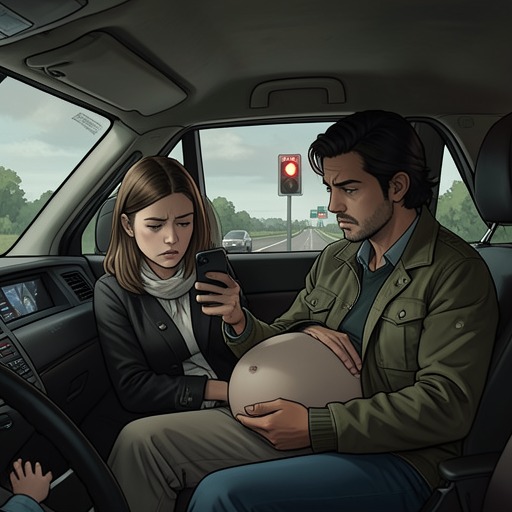
The accident occurs while Travis McCoy is driving a black Chevrolet Suburban with Penelope McCoy beside him. Penelope is pregnant and on the way to her first prenatal appointment, a fact that gives the journey an unusually concentrated emotional stake. Travis is excited about the pregnancy because he missed much of Max’s early life and now hopes to participate fully in fatherhood. Penelope tries to make him relax and enjoy the appointment, but his impatience with the slow drive already reveals how intensely he is invested in reaching medical care and beginning this new stage of family life.
The immediate cause is the erratic behavior of an eighteen-wheeler. The truck changes lanes and nearly strikes them, then slows abruptly in front of the Suburban. The truck driver later explains that he had been struggling to stay awake and panicked when a tumbleweed drifted into the road. His explanation makes the collision both accidental and culpable: no deliberate attack caused the danger, but fatigue and poor control placed several drivers at risk. Travis experiences the event not as an abstract traffic mistake but as an assault on Penelope and their unborn child.
The Collision
When the truck slows, Travis grips the steering wheel and brakes hard. He tries to turn left to avoid it, but another car attempting to pass prevents him from changing lanes. Penelope screams and reaches for the handle above the door as the truck nearly stops in the middle of the road. Travis then yanks the wheel to the right and drives onto the shoulder. The Suburban’s left front bumper clips the rear of the eighteen-wheeler, sending the family vehicle spinning into a roadside ditch, where it skids over dirt and gravel before coming to a violent stop.
The physical aftermath is immediately legible through Penelope’s gestures. Travis looks over and sees tears running down her face; one hand remains attached to the overhead handle while the other protects her belly. He asks whether she is all right, but her first response is uncertain, reflecting the shock of the impact rather than reassurance. Travis leaves the driver’s seat, rushes around to her side, opens the door, and examines her as closely as he can. Penelope tells him that she is only shaken, yet the apparent relief lasts only briefly.
Fear, Anger, and Protection
The truck driver approaches and asks whether everyone is all right. Travis responds with immediate hostility, grabs the front of the man’s flannel shirt, and slams him against the truck’s hood. Although the driver is twice Travis’s size and a crowd begins to gather, Travis sees only the man whose actions have endangered his wife. His anger converts fear into physical confrontation, and his accusation that the driver could have killed Penelope shows how quickly his protective commitment becomes uncontrolled violence.
Penelope’s cry interrupts the confrontation. Travis turns and sees her standing beside the Suburban, one arm wrapped around her abdomen and the other gripping the vehicle for support. The horror and pain on her face instantly redirect him. He releases the driver, runs back to Penelope, and catches her in his arms. When she gasps that her stomach hurts, Travis sweeps her up and warns the truck driver that the man had better hope nothing is wrong with either Penelope or the baby. The reversal is central to the scene: Travis’s attention moves from punishing the apparent cause to caring for the endangered people in front of him.
Two highway patrol cars arrive, and the witnesses, Travis, and Penelope recount their versions of what happened. When the ambulance comes, paramedics examine Penelope and strap her to a stretcher despite her dismay. Travis tries to climb in after her, but a paramedic says there is not enough room and attempts to hold him back. Travis refuses to be separated from his wife and child, insisting that he is going with her. His demand is not merely an expression of panic; it dramatizes the family role he has repeatedly chosen and publicly claimed.
Consequences and Medical Stakes
The accident changes the emotional meaning of the prenatal visit. Before the crash, the appointment represents anticipation and Travis’s hope to make up for the time he lost with Max. After the crash, medical care becomes urgent protection against an unknown threat. Penelope’s pain transforms pregnancy from a joyful future promise into a condition requiring immediate examination, and Travis’s insistence on accompanying her shows that fatherhood, for him, is now inseparable from physical presence during danger.
The event also exposes a recurring weakness in Travis’s character. His stubbornness has helped him overcome the unlikely path from a small-town boy to a college scholarship recipient and professional quarterback, but the same refusal to yield has endangered his family in the past and now fuels his attack on the truck driver. The accident therefore repeats the book’s larger contrast between athletic aggression and domestic responsibility. On the football field, decisive force can be a virtue; beside a pregnant wife in distress, the same impulse must be restrained and redirected.
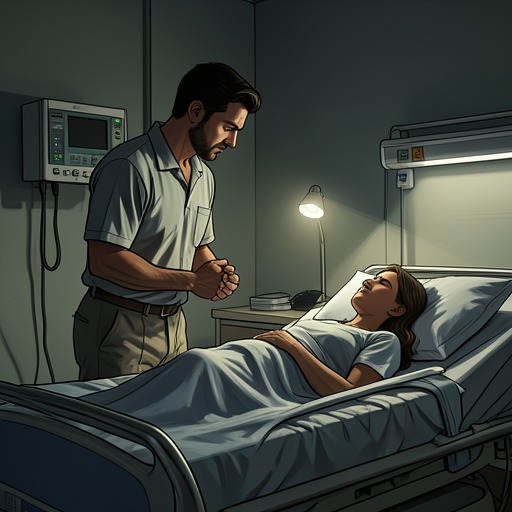
The scene’s danger is not resolved by the crash itself. Penelope’s pain requires an ambulance and continued medical attention, and the later birth sequence establishes that the pregnancy proceeds to labor under professional supervision. Dr. Edward Chan eventually announces that Penelope is fully dilated and ready to have her daughter. The accident thus stands within a larger movement from threatened pregnancy to childbirth: the family passes through fear, emergency care, and uncertainty before reaching the birth that confirms the continuation of the McCoy family line.
Narrative Significance
As a value-shifting event, the collision moves the family’s situation from domestic anticipation to possible loss, then toward renewed commitment through emergency care. Its power comes from the gap between the modest purpose of the trip and the scale of what is suddenly at risk. A prenatal appointment should be routine; instead, a distracted and exhausted truck driver turns the highway into a threshold between the family Travis has built and the family he might lose.
The accident also functions as a concrete test of the story’s family-first ethic. Travis has already endured a separated shoulder that placed him on the Miami Sharks’ injured reserve list, and he has carried the old wound of losing Loralie McCoy after her battle with Acute Lymphoblastic Leukemia. Those earlier bodily and familial losses help explain why Penelope’s pain produces such an immediate crisis response, but the highway scene gives his protective instinct a new object: not only the woman he once left behind, but also the unborn child whose future he is determined to share.
Ultimately, the crash is significant because it makes Travis’s promises physical. He has pledged himself to Penelope, sought Max’s legal change to McCoy, and helped create a household through marriage. On the roadside, those commitments become action: he checks Penelope’s body, carries her when the pain begins, refuses to let medical personnel take her away alone, and confronts the person he believes caused the danger. The event does not make Travis perfectly controlled, but it reveals the depth of his transformation from an absent partner and father into a man whose first instinct is to remain with his family when everything is suddenly uncertain.